Not all retaining wall materials survive Central Texas. Learn which options handle clay soil, heavy rain, and heat—and which ones fail within months.
Share:
Summary:
You’re looking at a sloped yard that’s washing away every time it rains. Or maybe you’ve got a wall that’s already leaning and you’re wondering what went wrong. The material you choose for a retaining wall in Central Texas isn’t just about looks—it’s about whether that wall is still standing straight in five years or needs a complete rebuild.
Clay soil that swells and shrinks. Storms that dump inches in an hour. Heat that bakes everything for months. Your retaining wall has to handle all of it. This isn’t about picking the prettiest stone at the supply yard. It’s about understanding what actually works here, what the failure points are, and how to avoid the mistakes that cost homeowners thousands in repairs. Let’s start with what makes Central Texas different.
Central Texas puts more stress on retaining walls than most regions. The clay-heavy soil expands when saturated and contracts during dry spells, creating constant push-and-pull pressure against your wall. That cycle happens dozens of times a year.
Then there’s the rain. Flash flooding and heavy spring storms can dump water behind a wall faster than poor drainage can handle it. When that happens, hydrostatic pressure builds up and starts pushing the wall forward. Even the strongest materials fail if water has nowhere to go.
Heat adds another layer. Scorching summers and UV exposure can degrade certain materials over time, especially if they weren’t designed for this climate. The wrong choice doesn’t just look bad—it buckles, cracks, or leans within the first few seasons.
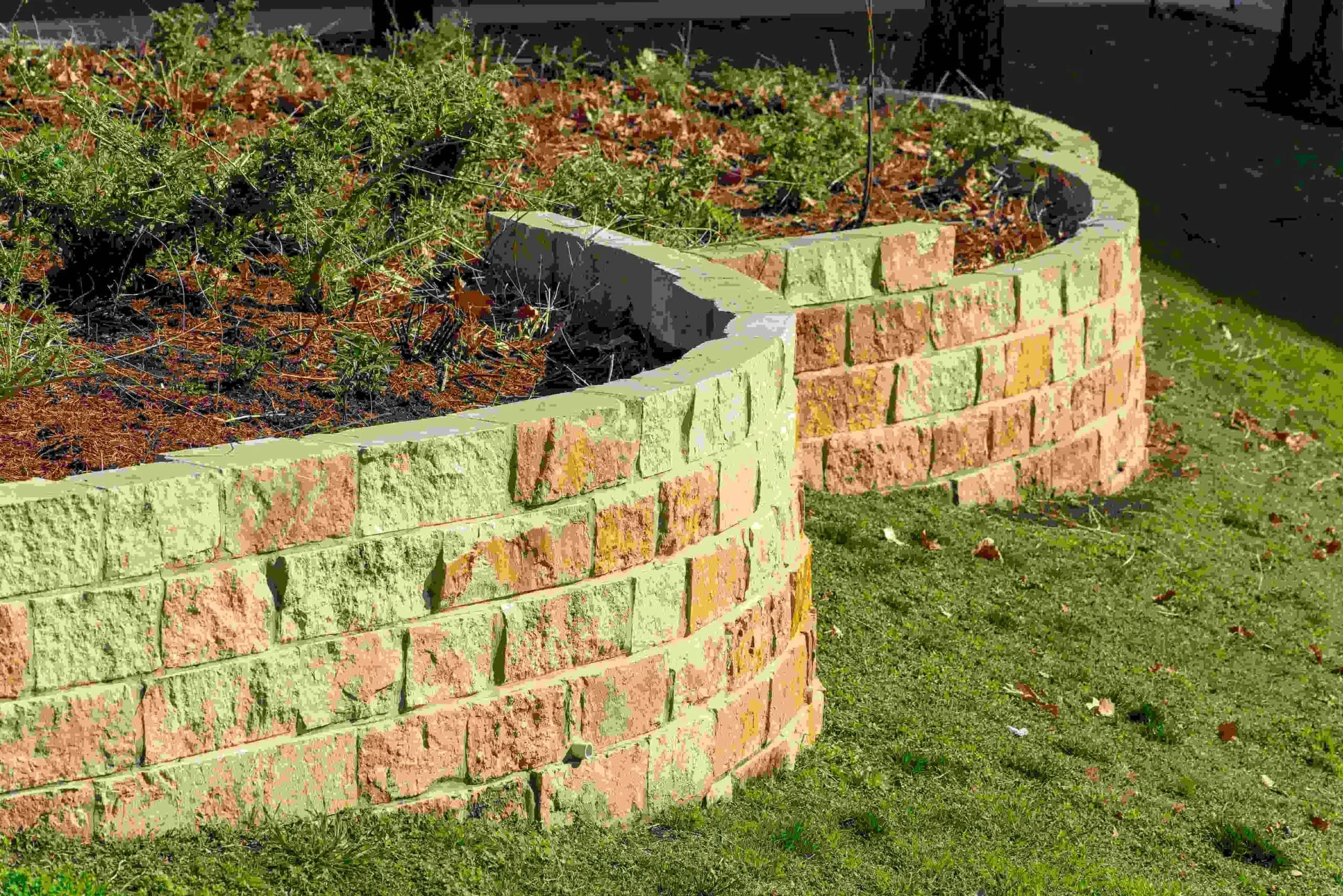
The black and reddish clays common across Waco, TX and surrounding counties like McClennan, Bell, and Hill Counties are notorious for their expansive properties. These soils absorb water slowly, but when they do, they swell significantly. During droughts, they shrink and crack.
That movement creates lateral pressure against retaining walls that other regions don’t experience to the same degree. A wall that works perfectly in sandy soil might fail here within a year because the constant expansion and contraction stress the structure beyond its limits.
Proper material selection accounts for this. Interlocking concrete blocks, for example, have some flexibility built into their design. They can shift slightly without cracking, which helps them tolerate soil movement. Poured concrete, on the other hand, is rigid—it either holds or it cracks. There’s no middle ground.
The depth of your wall’s foundation also matters more here. Shallow footings don’t provide enough stability when clay soil is pushing and pulling. Most professionals recommend excavating at least 12 inches below grade and using compacted gravel as a base. That creates a stable platform that won’t shift when the soil around it moves.
Drainage becomes critical in clay soils because water doesn’t filter through quickly. It sits behind the wall, building pressure. Without weep holes, French drains, or gravel backfill, that water has nowhere to go. The result is a wall that bows, leans, or collapses—even if the material itself is strong enough to handle the load.
You also need to think about tree roots. Oaks, pecans, and other trees common to Central Texas send roots searching for moisture. Those roots can grow into drainage paths, clog weep holes, and even displace blocks or stones from within. Choosing a material is only part of the equation. You also have to plan for what the soil and surrounding environment will do over time.
Drainage isn’t optional. It’s the difference between a retaining wall that lasts decades and one that fails in months. When water saturates the soil behind a wall, it creates hydrostatic pressure—a force that can push thousands of pounds against the structure. No material can withstand that indefinitely without proper drainage.
The most common mistake is skipping the drainage system entirely. Builders stack blocks or pour concrete and backfill with native soil, assuming the wall’s strength will hold. It might, for a while. But after the first heavy rain, water starts pooling behind the wall. Pressure builds. The wall begins to bow or lean. Eventually, it fails.
Proper drainage starts with a gravel backfill. Clean, angular gravel allows water to flow down the back of the wall instead of saturating the soil. At the base, a perforated drain pipe collects that water and directs it away from the structure. Weep holes along the face of the wall provide additional escape routes, relieving pressure before it becomes a problem.
In Waco and surrounding areas, where flash floods and intense storms are common, drainage design has to account for worst-case scenarios. A system that handles light rain might be overwhelmed when a storm dumps three inches in an hour. That’s when poorly designed walls collapse.
Clay soil makes drainage even more critical. Because clay doesn’t absorb water quickly, runoff tends to pool rather than filter through. If your wall is located downslope from a roof, driveway, or other impervious surface, you’re funneling even more water toward the structure. That concentrated flow can erode soil at the base, undermine the foundation, and destabilize the entire wall.
French drains are a common solution for properties with significant runoff. These systems intercept water before it reaches the wall and redirect it to a safe outlet. Combining a French drain with proper backfill and weep holes creates a multi-layered defense against water damage.
Some materials handle moisture better than others. Gabion walls, for example, allow water to pass through the wire cages, reducing pressure naturally. Dry-stacked stone walls have joints that release water instead of trapping it. Poured concrete and mortared stone, on the other hand, create impermeable barriers—which means drainage has to be engineered into the design from the start.
Ignoring drainage doesn’t just risk the wall. It can also lead to foundation damage, landscape erosion, and costly repairs that far exceed the original project cost. Proper planning and material selection that accounts for water management is the only way to avoid those problems.
Want live answers?
Connect with a Huaco Landscape & Irrigation expert for fast, friendly support.
Not every material performs the same in Central Texas conditions. Some handle heat and clay soil better than others. Some require more maintenance. Some cost significantly more upfront but last longer. Understanding the differences helps you match the material to your property’s specific needs.
Concrete blocks, natural stone, poured concrete, brick, and timber are the most common options. Each has strengths and weaknesses. The right choice depends on wall height, soil conditions, budget, and how much maintenance you’re willing to handle over time.
Let’s break down how each material stacks up in real-world Central Texas conditions.
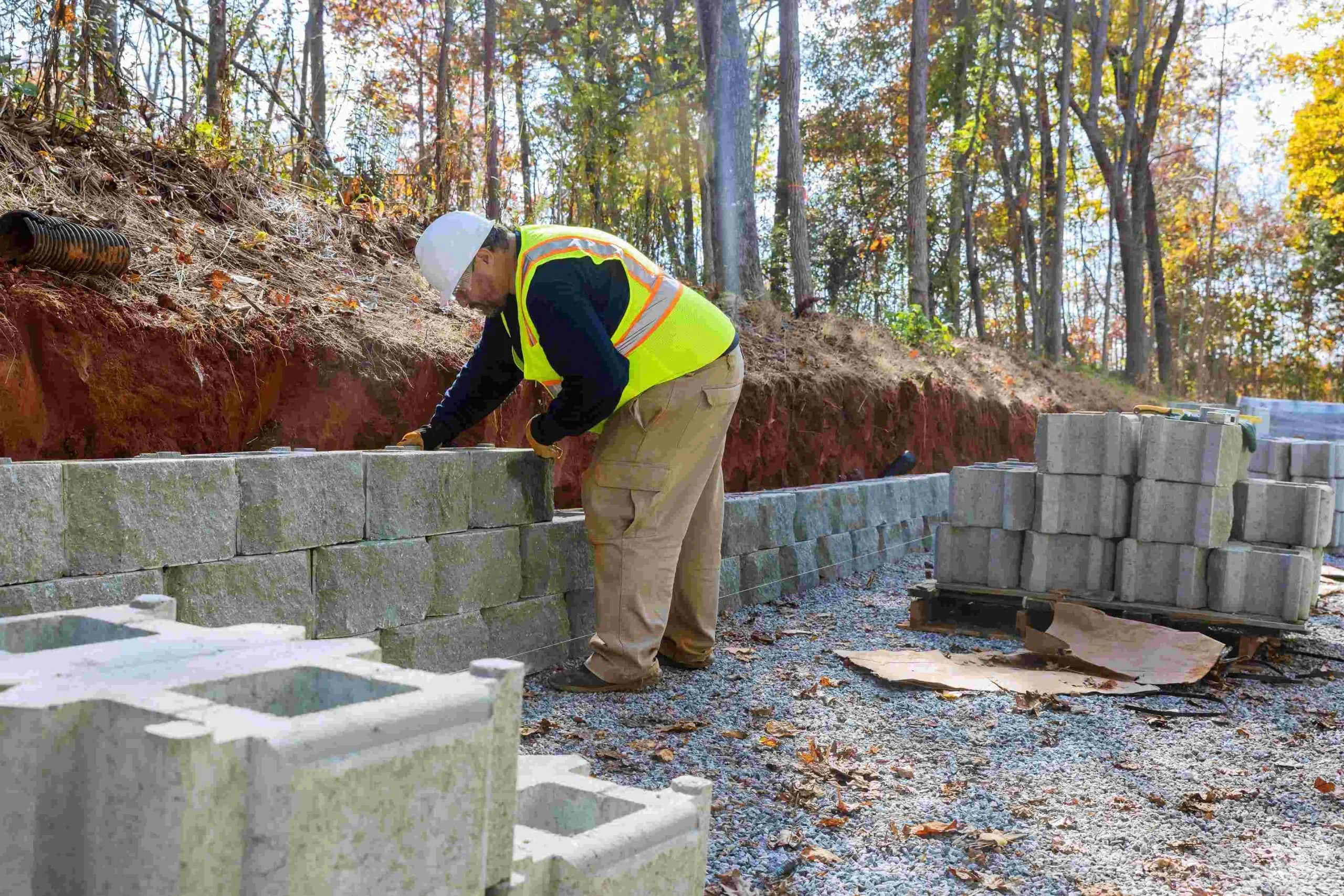
Interlocking concrete blocks are the most popular choice for retaining walls in Waco, TX and across Central Texas. They’re affordable, durable, and versatile. The blocks come in various sizes, shapes, and finishes, making it easy to create a design that fits your property.
The interlocking design is key. Most modern blocks have lips or pins that lock each row together without mortar. This creates a flexible structure that can tolerate minor soil movement without cracking. In areas with expansive clay soil, that flexibility is a major advantage.
Concrete blocks also handle heat and UV exposure well. They don’t rot, warp, or degrade in the sun the way timber does. With minimal maintenance—usually just occasional cleaning—a well-built concrete block wall can last 50 years or more.
Installation is relatively straightforward for walls under four feet. The blocks are heavy enough to provide stability but light enough to handle without heavy equipment. For taller walls, geogrid reinforcement is often used. This involves burying layers of grid material into the soil behind the wall, tying the structure into the earth and creating a more stable system.
Cost is another reason concrete blocks are popular. Depending on the style and finish, expect to pay between $15 and $36 per square foot installed. That’s more affordable than natural stone or poured concrete but still delivers long-term durability.
The main downside is appearance. While manufacturers offer textured and colored options, concrete blocks don’t have the same natural look as stone. For some properties, especially those with rustic or traditional architecture, the industrial feel of concrete might not be the right fit.
Drainage is straightforward with interlocking blocks. The joints between blocks allow some water to escape, and it’s easy to integrate gravel backfill and drain pipes into the installation. As long as the drainage system is designed properly, concrete blocks handle Central Texas rainfall without issue.
Natural stone delivers a timeless, high-end look that concrete blocks can’t match. Limestone, in particular, is a natural fit for Central Texas. It’s locally available, blends with the landscape, and performs well in the climate. The key is choosing structural-grade stone, not soft veneer that can flake when temperatures swing.
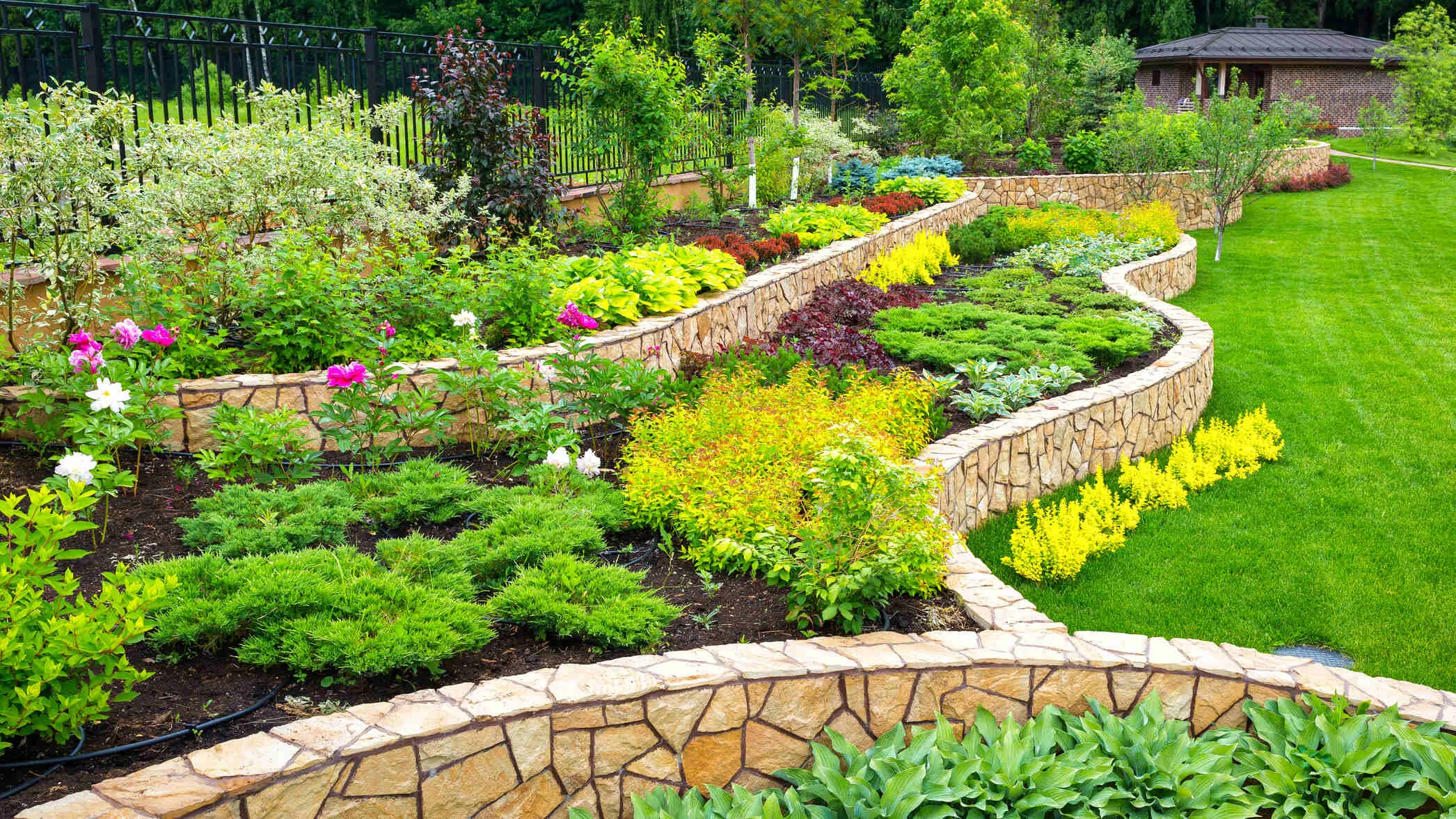
Stone walls can be dry-stacked or mortared. Dry-stacked walls allow water to pass through the joints, providing natural drainage. Mortared walls are more stable but require engineered drainage systems. Both options are labor-intensive, which drives up the cost. Expect to pay between $25 and $40 per square foot for natural stone retaining walls.
The durability of stone is hard to beat. A well-built stone wall can last 100 years or more with minimal maintenance. It resists heat, UV exposure, and moisture. The natural texture and color variation create a look that improves over time as the stone weathers and blends into the environment.
Poured concrete is the strongest option for tall retaining walls or walls supporting heavy loads. It’s rigid, durable, and can be shaped into custom designs. Poured concrete works well in modern landscapes where clean lines and a sleek aesthetic are priorities.
The downside is cost and complexity. Pouring concrete requires skilled labor, formwork, and reinforcement. Prices range from $27 to $40 per square foot, and the process takes longer than installing blocks. Concrete can also crack over time, especially if drainage isn’t managed properly or if the foundation settles.
Brick offers a traditional look that complements many home styles. It’s durable, handles moisture well, and can last for decades. However, brick walls require mortar, which means they’re less flexible than interlocking blocks. In areas with significant soil movement, mortar joints can crack. Installation is also labor-intensive, making brick one of the more expensive options.
Timber is the most budget-friendly material, but it has the shortest lifespan in Central Texas. Pressure-treated wood can last 15 to 20 years, but constant moisture and heat accelerate rot and decay. Timber works well for small garden walls or decorative borders but isn’t recommended for structural walls over three feet tall.
Each material has a place. The right choice depends on your budget, the wall’s purpose, and how much maintenance you’re willing to handle. For most residential projects in Waco and surrounding counties, interlocking concrete blocks or natural stone provide the best balance of cost, durability, and performance.
Choosing the right material is only part of building a retaining wall that lasts. Drainage, foundation depth, and proper installation matter just as much. Cutting corners on any of those leads to problems down the road—walls that lean, crack, or fail entirely.
In Central Texas, where clay soil, heavy rain, and heat create unique challenges, working with a team that understands local conditions makes the difference. The material you choose should match your property’s soil, slope, and drainage needs. It should also fit your budget and aesthetic goals without sacrificing long-term performance.
If you’re dealing with erosion, sloped terrain, or a wall that’s already showing signs of failure, we can help. We’ve been handling retaining walls, hardscaping, and drainage solutions across Waco, TX and surrounding counties since 2010. Our team knows what works here and what doesn’t—and we’re available when you need us, not three months from now.
Article details:
Share:
Continue learning: